



NYUMBANI ABOUTUS WAPI MUDA MAWASILIANO

Average Weather in Malindi Kenya
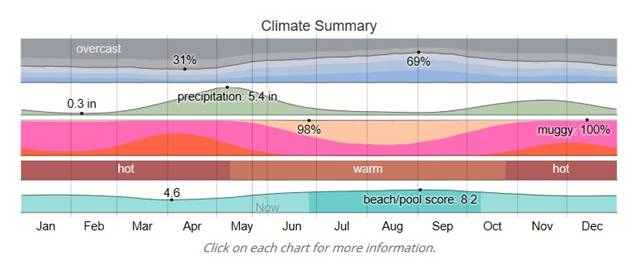
In Malindi, the summers are short, hot, and mostly
cloudy; the winters are warm, dry, windy, and partly cloudy; and it is oppressive
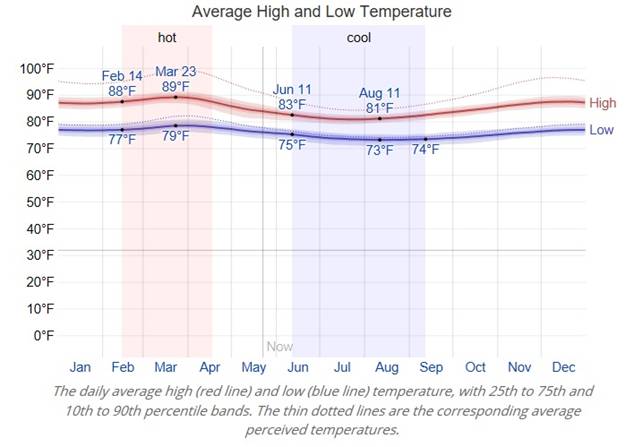
year round. Over the course of the year, the temperature typically varies from 73°F to 89°F and is rarely below 71°F or above 91°F.
Based on the beach/pool score, the best
time of year to visit Malindi for hot-weather activities is from late June to early October.
Temperature
The
hot
season
lasts for 2.1
months,
from February
14
to April
17,
with an average daily high temperature above 88°F. The hottest day of the
year is March
23,
with an average high of 89°F and low of 79°F.
The
cool
season
lasts for 3.0
months,
from June
11
to September
12,
with an average daily high temperature below 83°F. The coldest day of the
year is August
11,
with an average low of 73°F and high of 81°F.
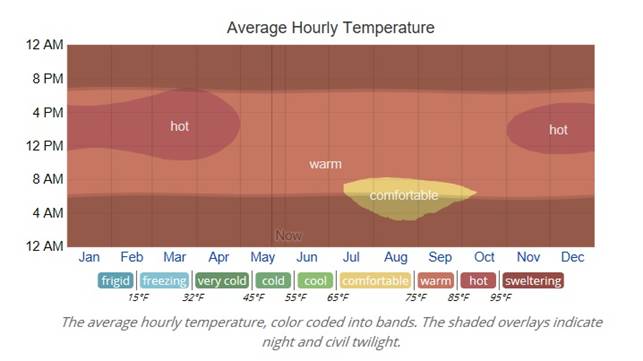
The figure below shows you a compact characterization of
the entire year of hourly average temperatures. The horizontal axis is the day of
the year, the vertical axis is the hour of the day, and the color is the
average temperature for that hour and day.
Salvador,
Brazil (5,409 miles away) is the far-away foreign place with
temperatures most similar to Malindi (view
comparison).
Clouds
In
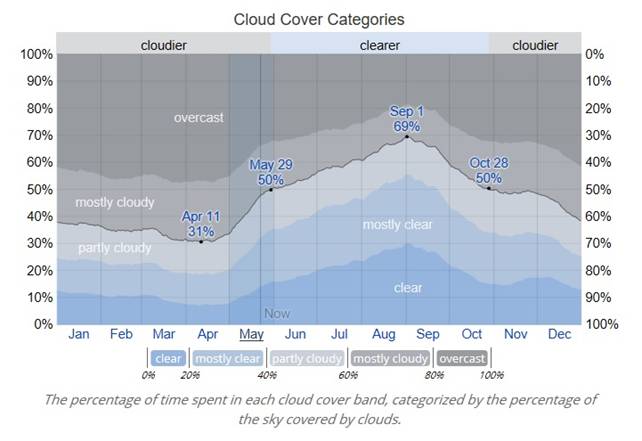
Malindi, the average percentage of the sky covered by clouds experiences
significant seasonal variation over the course of the year.
The clearer part of the year in Malindi begins around May
29 and lasts for 5.0 months, ending around October 28. On September 1, the
clearest day of the year, the sky is clear, mostly clear, or partly cloudy 69%
of the time, and overcast or mostly cloudy 31% of the time.
The cloudier part of the year begins around October 28
and lasts for 7.0 months, ending around May 29. On April 11, the cloudiest day
of the year, the sky is overcast or mostly cloudy 69% of the time, and clear,
mostly clear, or partly cloudy 31% of the time.
Precipitation
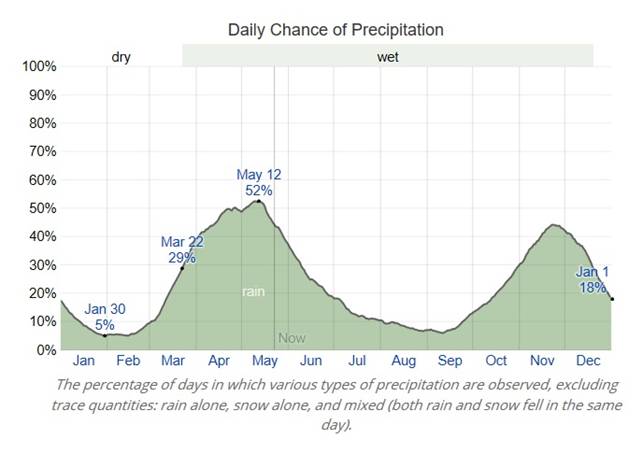
A wet day is one with at least 0.04 inches of liquid or
liquid-equivalent precipitation. The chance of wet days in Malindi varies
significantly throughout the year.
The wetter season lasts 8.9 months, from March 22 to
December 20, with a greater than 29% chance of a given day being a wet day. The
chance of a wet day peaks at 52% on May 12.
The drier season lasts 3.1 months, from December 20 to
March 22. The smallest chance of a wet day is 5% on January 30.
Among wet days, we distinguish between those that
experience rain alone, snow alone, or a mixture of the two. Based on this
categorization, the most common form of precipitation throughout the year is
rain alone, with a peak probability of 52% on May 12.
Rainfall
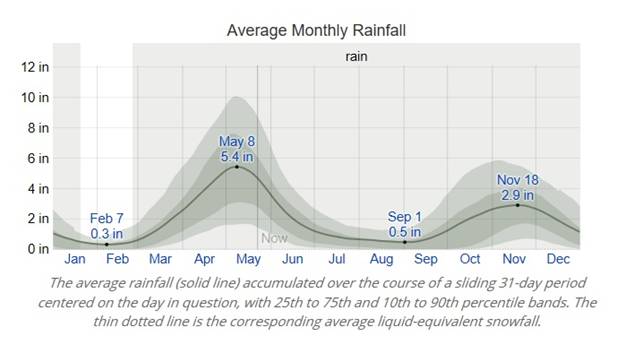
To show variation within the months and not just the
monthly totals, we show the rainfall accumulated over a sliding 31-day period
centered around each day of the year. Malindi experiences extreme seasonal
variation in monthly rainfall.
The rainy period of the year lasts for 11 months, from
February 25 to January 20, with a sliding 31-day rainfall of at least 0.5
inches. The most rain falls during the 31 days centered around May 8, with an
average total accumulation of 5.4 inches.
The rainless period of the year lasts for 1.1 months,
from January 20 to February 25. The least rain falls around February 7, with an
average total accumulation of 0.3 inches.
Sun
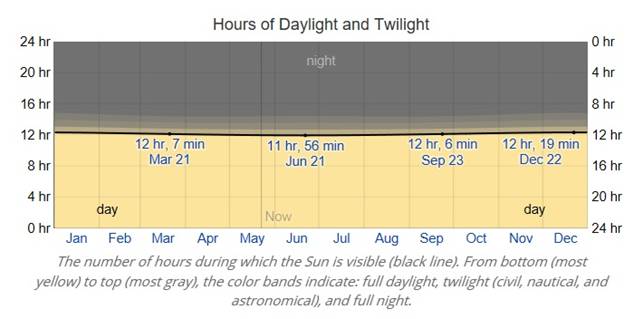
The
length of the day in Malindi does not vary substantially over the course of the
year, staying within 18 minutes of 12 hours throughout. In 2019, the shortest day is June 21, with 11 hours, 56 minutes of
daylight; the longest day is December 22, with 12 hours, 19 minutes of
daylight.
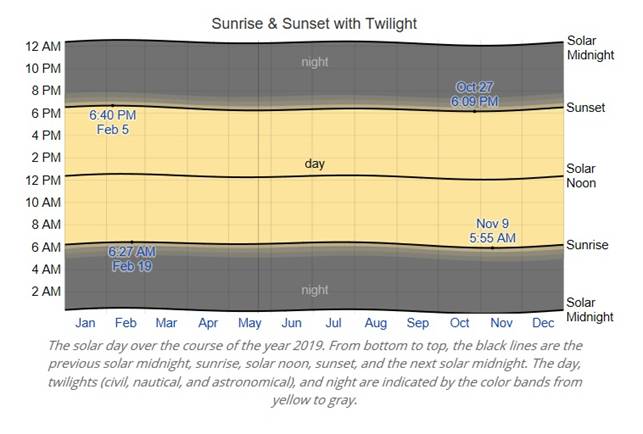
The earliest sunrise is at 5:55 AM on November 9, and the
latest sunrise is 31 minutes later at 6:27 AM on February 19. The earliest
sunset is at 6:09 PM on October 27, and the latest sunset is 31 minutes later
at 6:40 PM on February 5.
Daylight saving time (DST) is not observed in Malindi
during 2019.
Humidity
We base the humidity comfort level on the dew point, as
it determines whether perspiration will evaporate from the skin, thereby
cooling the body. Lower dew points feel drier and higher dew points feel more
humid. Unlike temperature, which typically varies significantly between night
and day, dew point tends to change more slowly, so while the temperature may
drop at night, a muggy day is typically followed by a muggy night.
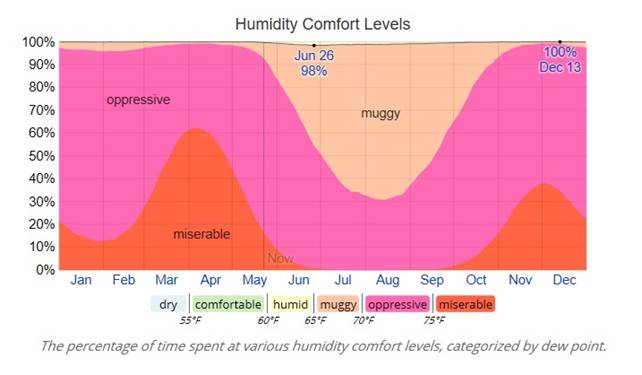
The perceived humidity level in Malindi, as measured by
the percentage of time in which the humidity comfort level is muggy,
oppressive, or miserable, does not vary significantly over the course of the
year, staying within 1% of 99% throughout.
Wind
This section discusses the wide-area hourly average wind
vector (speed and direction) at 10 meters above the ground. The wind
experienced at any given location is highly dependent on local topography and
other factors, and instantaneous wind speed and direction vary more widely than
hourly averages.
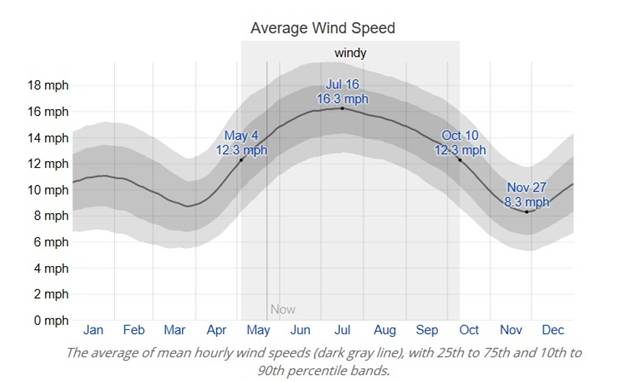
The average hourly wind speed in Malindi experiences
significant seasonal variation over the course of the year.
The windier part of the year lasts for 5.2 months, from
May 4 to October 10, with average wind speeds of more than 12.3 miles per hour.
The windiest day of the year is July 16, with an average hourly wind speed of
16.3 miles per hour.
The calmer time of year lasts for 6.8 months, from
October 10 to May 4. The calmest day of the year is November 27, with an
average hourly wind speed of 8.3 miles per hour.
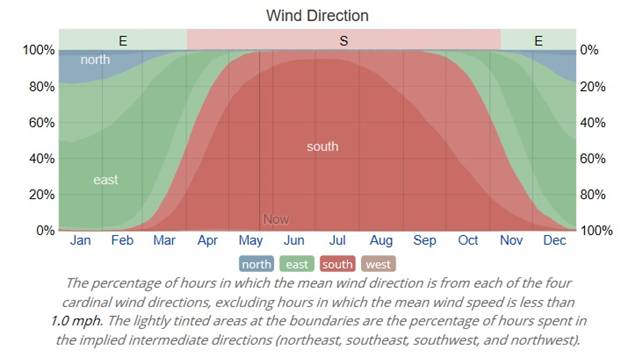
The predominant average hourly wind direction in Malindi
varies throughout the year.
The wind is most often from the south for 7.2 months,
from April 1 to November 8, with a peak percentage of 100% on June 24. The wind
is most often from the east for 4.8 months, from November 8 to April 1, with a
peak percentage of 82% on January 1.
Water
Temperature
Malindi
is located near a large body of water (e.g., ocean, sea, or large lake). This section reports on the wide-area average surface temperature of that
water.
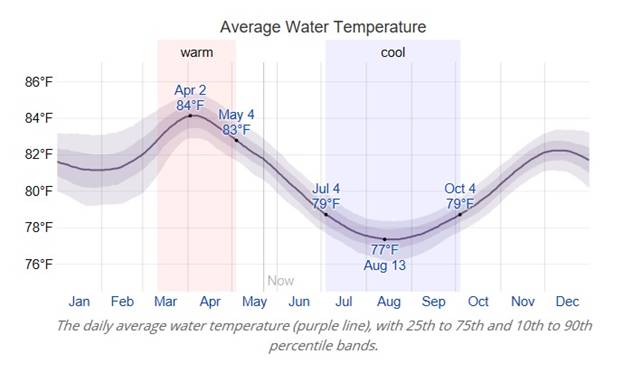
The average water temperature experiences some seasonal
variation over the course of the year.
The time of year with warmer water lasts for 1.8 months,
from March 10 to May 4, with an average temperature above 83°F. The day of the
year with the warmest water is April 2, with an average temperature of 84°F.
The time of year with cooler water lasts for 3.0 months,
from July 4 to October 4, with an average temperature below 79°F. The day of
the year with the coolest water is August 13, with an average temperature of
77°F.
Best
Time of Year to Visit
To
characterize how pleasant the weather is in Malindi throughout the year, we
compute two travel scores.
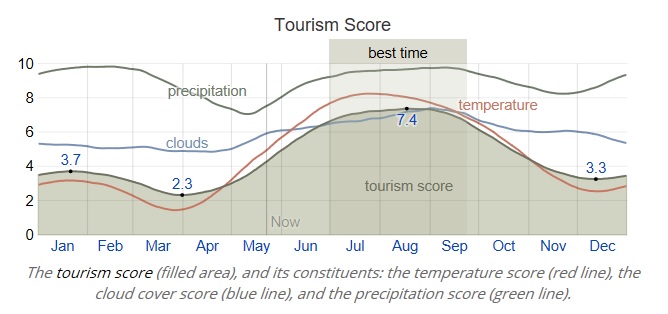
The
tourism score favors clear, rainless days with perceived temperatures between
65°F and 80°F. Based on this score, the best time of year to visit Malindi for
general outdoor tourist activities is from late June to late September, with a
peak score in the third week of August.
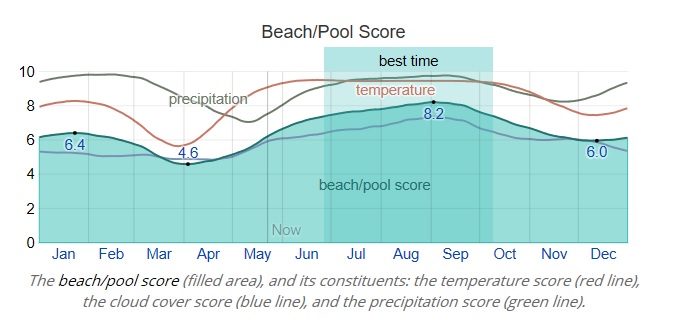
The
beach/pool score favors clear, rainless days with perceived temperatures
between 75°F and 90°F. Based on this score, the best time of year to visit
Malindi for hot-weather activities is from late June to early October, with a
peak score in the first week of September.
Methodology
For
each hour between 8:00 AM and 9:00 PM of each day in the analysis period (1980
to 2016), independent scores are computed for perceived temperature, cloud
cover, and total precipitation. Those scores are combined into a single hourly
composite score, which is then aggregated into days, averaged over all the
years in the analysis period, and smoothed.
Our
cloud cover score is 10 for fully clear skies, falling linearly to 9 for mostly
clear skies, and to 1 for fully overcast skies.
Our
precipitation score, which is based on the three-hour precipitation centered on
the hour in question, is 10 for no precipitation, falling linearly to 9 for
trace precipitation, and to 0 for 0.04 inches of precipitation or more.
Our
tourism temperature score is 0 for perceived temperatures below 50°F, rising
linearly to 9 for 65°F, to 10 for 75°F, falling linearly to 9 for 80°F, and to
1 for 90°F or hotter.
Our
beach/pool temperature score is 0 for perceived temperatures below 65°F, rising
linearly to 9 for 75°F, to 10 for 82°F, falling linearly to 9 for 90°F, and to
1 for 100°F or hotter.
Growing
Season
Definitions
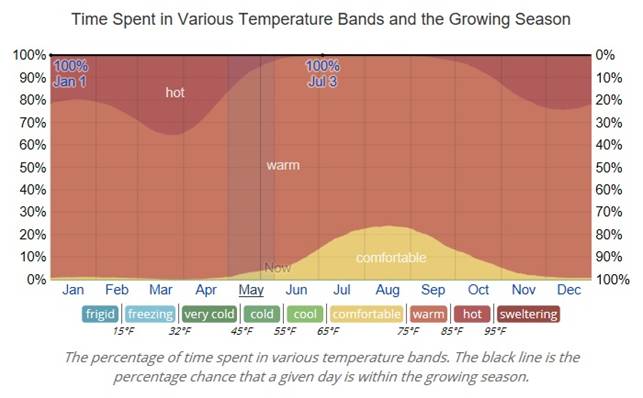
of the growing season vary throughout the world, but for the purposes of this
report, we define it as the longest continuous period of non-freezing
temperatures (≥ 32°F) in the year (the calendar year in the Northern
Hemisphere, or from July 1 until June 30 in the Southern Hemisphere).
Temperatures
in Malindi are sufficiently warm year round that it is not entirely meaningful
to discuss the growing season in these terms. We nevertheless include the chart below as an illustration of the
distribution of temperatures experienced throughout the year.
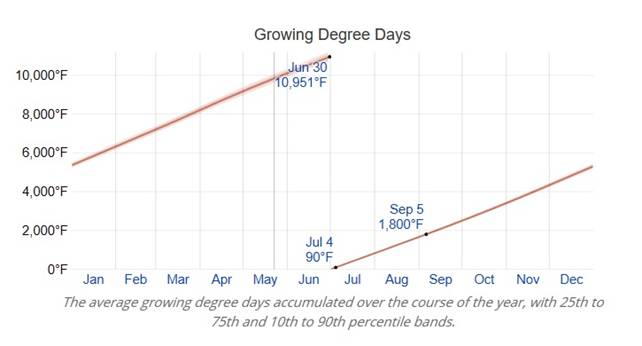
Growing degree days are a measure of yearly heat accumulation
used to predict plant and animal development, and defined as the integral of
warmth above a base temperature, discarding any excess above a maximum
temperature. In this report, we use a base of 50°F and a cap of 86°F.
Solar Energy
This section discusses the total daily incident shortwave
solar energy reaching the surface of the ground over a wide area, taking full
account of seasonal variations in the length of the day, the elevation of the
Sun above the horizon, and absorption by clouds and other atmospheric
constituents. Shortwave radiation includes visible light and ultraviolet
radiation.
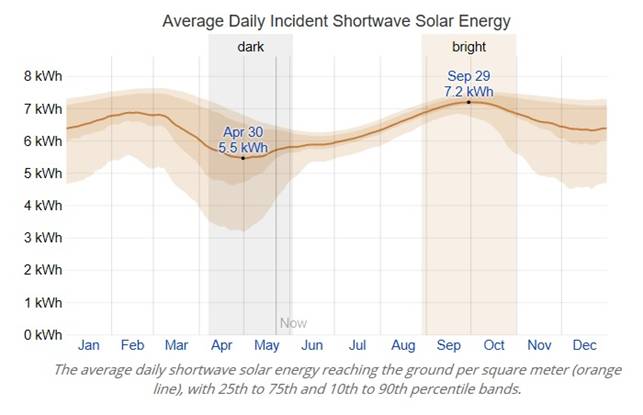
The average daily incident shortwave solar energy
experiences some seasonal variation over the course of the year.
The brighter period of the year lasts for 2.1 months,
from August 28 to October 31, with an average daily incident shortwave energy
per square meter above 6.9 kWh. The brightest day of the year is September 29,
with an average of 7.2 kWh.
The darker period of the year lasts for 1.9 months, from
April 7 to June 3, with an average daily incident shortwave energy per square
meter below 5.8 kWh. The darkest day of the year is April 30, with an average
of 5.5 kWh.
Topography
For the purposes of this report, the geographical
coordinates of Malindi are -3.218 deg latitude, 40.117 deg longitude, and 43 ft
elevation.
The topography within 2 miles of Malindi contains only
modest variations in elevation, with a maximum elevation change of 121 feet and
an average elevation above sea level of 41 feet. Within 10 miles contains only
modest variations in elevation (518 feet). Within 50 miles contains significant
variations in elevation (1,804 feet).
The area within 2 miles of Malindi is covered by trees
(27%), water (26%), artificial surfaces (23%), and cropland (16%), within 10
miles by water (51%) and trees (22%), and within 50 miles by water (55%) and
trees (26%).
Data Sources
This report illustrates the typical weather in Malindi,
based on a statistical analysis of historical hourly weather reports and model
reconstructions from January 1, 1980 to December 31, 2016.
Temperature and Dew Point
There are 2 weather stations near enough to contribute to
our estimation of the temperature and dew point in Malindi.
For each station, the records are corrected for the
elevation difference between that station and Malindi according to the International Standard Atmosphere , and by the relative change present in the MERRA-2 satellite-era reanalysis between the two locations.
The estimated value at Malindi is computed as the
weighted average of the individual contributions from each station, with
weights proportional to the inverse of the distance between Malindi and a given
station.
The stations contributing to this reconstruction are: Malindi Airport (100%, 2.1 kilometers, southwest) and Manda Airport (0.2%, 139 kilometers, northeast).
Other Data
All data relating to the Sun's position (e.g., sunrise
and sunset) are computed using astronomical formulas from the book, Astronomical Tables of the Sun, Moon
and Planets , by Jean Meeus.
All other weather data, including cloud cover,
precipitation, wind speed and direction, and solar flux, come from NASA's MERRA-2 Modern-Era Retrospective Analysis . This reanalysis combines a variety of wide-area measurements in a
state-of-the-art global meteorological model to reconstruct the hourly history
of weather throughout the world on a 50-kilometer grid.
Land Use data comes from the Global Land Cover SHARE database , published by the Food and Agriculture Organization of the United Nations.
Elevation data comes from the Shuttle Radar Topography Mission (SRTM) , published by NASA's Jet Propulsion Laboratory.
Names, locations, and time zones of places and some
airports come from the GeoNames
Geographical Database .
Time zones for aiports and weather stations are provided
by AskGeo.com .
Maps are © Esri, with data from National Geographic,
Esri, DeLorme, NAVTEQ, UNEP-WCMC, USGS, NASA, ESA, METI, NRCAN, GEBCO, NOAA,
and iPC.
Disclaimer
The information on this site is provided as is, without
any assurances as to its accuracy or suitability for any purpose. Weather data
is prone to errors, outages, and other defects. We assume no responsibility for any
decisions made on the basis of the content presented on this site.
We
draw particular cautious attention to our reliance on the MERRA-2 model-based
reconstructions for a number of important data series. While having the
tremendous advantages of temporal and spatial completeness, these
reconstructions: (1) are based on computer models that may have model-based
errors, (2) are coarsely sampled on a 50 km grid and are therefore unable to
reconstruct the local variations of many microclimates, and (3) have particular
difficulty with the weather in some coastal areas, especially small islands.
We
further caution that our travel scores are only as good as the data that
underpin them, that weather conditions at any given location and time are
unpredictable and variable, and that the definition of the scores reflects a
particular set of preferences that may not agree with those of any particular
reader.
FONT:
weatherspark.com

DAURIN Ltd - MANCHESTER GB
MAUAYOTE.COM
– info@mauayote.com - maua@daurin.com
© 2019 DAURIN – TUTTI I DIRITTI RISERVATI. Le immagini sono puramente
indicative, I diritti
intellettuali dei disegni sono riservati ai professionisti detentori dei
progetti.
© 2019 DAURIN - ALL RIGHTS ARE RESERVED. The images are purely indicative,
the intellectual rights of the drawings are reserved for professional project
owners.
© 2019 DAURIN - HAKI ZOTE ZINAFANYA. Picha hizo ni dalili tu, haki za
kiakili za michoro zinahifadhiwa kwa wamiliki wa mradi wa kitaaluma.